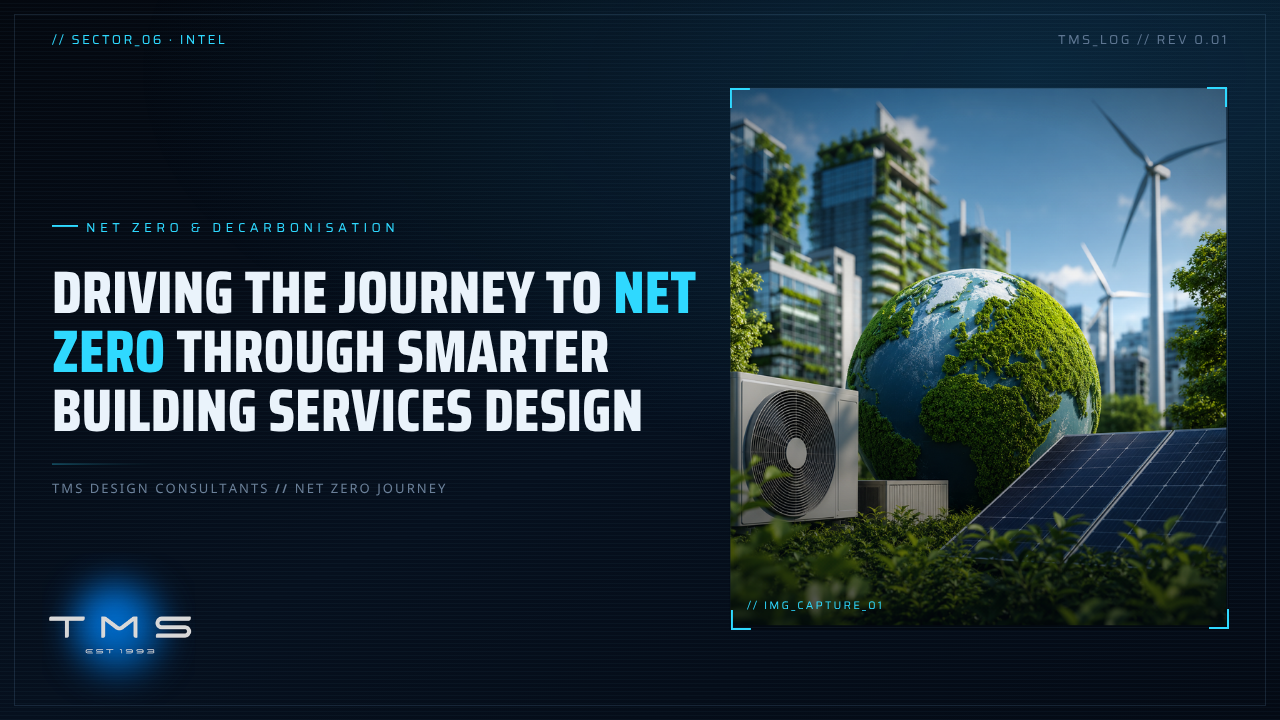
The built environment is responsible for a significant proportion of global carbon emissions, making the construction industry one of the most important sectors in the transition towards a low-carbon future. As legislation evolves and sustainability targets become increasingly ambitious, building owners, developers and contractors are seeking engineering partners who can deliver practical, commercially viable solutions that reduce environmental impact without compromising performance.
At TMS, sustainability shapes how we approach every project. From the earliest design stages through to project delivery, we work with clients to develop building services that are efficient, future-ready and aligned with modern decarbonisation objectives.
That commitment extends beyond our client work. As part of our own pledge to achieve Net Zero, we've taken significant steps to calculate, reduce and offset our operational carbon emissions, earning certification from Carbon Neutral Britain. We believe that if we're advising clients on sustainable engineering solutions, we should be leading by example in the way we operate our own business.
Engineering for a Low Carbon Future
Modern building services have evolved dramatically over the last decade. The focus is no longer solely on providing heating, cooling and ventilation. It is about delivering these services in the most energy-efficient and environmentally responsible way possible.
At TMS, we design Mechanical, Electrical and Public Health (MEP) systems for offices, healthcare, education, commercial and industrial buildings that reduce operational energy demand, improve building performance and support long-term sustainability goals.
Every project presents different challenges, which is why there is no universal solution. Instead, we assess each building individually, considering factors such as occupancy, usage patterns, available infrastructure, operational costs and future expansion to develop the most appropriate engineering strategy.
Supporting Building Decarbonisation
One of the biggest changes across the industry has been the move away from fossil fuel-based heating towards electrified systems that can be powered by increasingly renewable electricity generation.
Where appropriate, TMS specifies high-efficiency air source and water source heat pump systems that significantly reduce carbon emissions compared with traditional gas-fired heating. These technologies not only help future-proof buildings against tightening environmental legislation but can also deliver lower operating costs when designed correctly.
Our engineers also consider hybrid systems, heat recovery technologies and intelligent controls that maximise efficiency while maintaining occupant comfort throughout the building.
The objective is not to swap one piece of equipment for another, but to design complete systems that work together efficiently over the lifetime of the building.
Selecting More Sustainable HVAC Equipment
The equipment specified during the design phase has a lasting impact on a building's environmental performance.
TMS works with leading manufacturers to specify high-performance HVAC equipment that combines reliability, efficiency and sustainability. This includes selecting systems with excellent seasonal efficiencies, advanced inverter technology and intelligent control strategies that minimise unnecessary energy consumption.
Where possible, we also prioritise equipment using lower Global Warming Potential (GWP) refrigerants. As refrigerant regulations continue to tighten across the UK and Europe, selecting lower GWP alternatives helps reduce the environmental impact of air conditioning and heat pump installations while supporting compliance with evolving legislation.
Combined with careful system design, these technologies help reduce both direct emissions from refrigerants and indirect emissions associated with electricity consumption.
Energy Efficient Building Services Design
Equipment selection alone does not reduce carbon emissions. The greatest efficiencies often come from design that reduces unnecessary energy demand before systems are even installed.
Our engineers carefully consider factors including:
- Heating and cooling loads
- Ventilation strategies
- Heat recovery opportunities
- Plant sizing and diversity
- Pipework and ductwork efficiencies
- Variable speed pumping and fan systems
- Smart Building Management System (BMS) integration
- Lighting efficiency and controls
By optimising every aspect of the building services design, we help create systems that consume less energy throughout their operational life while remaining easier to maintain and operate.
Delivering Sustainable Design Through BIM
Our Building Information Modelling (BIM) workflows also contribute to more sustainable project delivery.
Developing coordinated 3D models allows potential clashes and design issues to be identified long before construction begins, reducing material waste, minimising costly rework and improving overall project efficiency.
Through collaborative design and immersive Virtual Reality walkthroughs, clients can review plant layouts, service routes and equipment locations before installation, allowing informed decisions to be made early in the project lifecycle.
The result is a smoother construction process, fewer on-site modifications and a more efficient use of materials and resources.
Leading by Example
Our commitment to sustainability extends beyond the projects we deliver.
As part of our Net Zero pledge, we've carried out a comprehensive assessment of our own carbon emissions, identifying opportunities to reduce our environmental impact across every aspect of the business.
This includes reviewing energy consumption, travel, procurement and day-to-day operations to ensure we're continually improving the way we work. Where emissions cannot yet be eliminated, they are responsibly offset through verified carbon reduction programmes, enabling us to achieve certification from Carbon Neutral Britain.
We see Net Zero not as a destination but as an ongoing process of continuous improvement.
Partnering With Clients for a Greener Future
The transition towards low-carbon buildings requires collaboration between consultants, contractors, manufacturers and clients. Success comes from making informed decisions early in the design process, balancing environmental responsibility with commercial practicality and long-term operational performance.
Whether delivering office refurbishments, healthcare facilities, education projects, commercial developments or industrial buildings, TMS works closely with project teams to identify opportunities for energy savings, carbon reduction and improved building performance.
By combining technical expertise with practical engineering experience, we help clients meet today's sustainability expectations while preparing for the demands of tomorrow.
Building Better, Together
Sustainability is shaping the future of construction, and building services engineering is central to that change.
Through intelligent design, innovative technologies, careful equipment selection and our own commitment to Net Zero, TMS is helping deliver buildings that are more efficient, more resilient and better for the environment.
As regulations tighten and expectations increase, we remain committed to designing smarter buildings, supporting our clients' sustainability ambitions and reducing carbon in the buildings we help deliver.