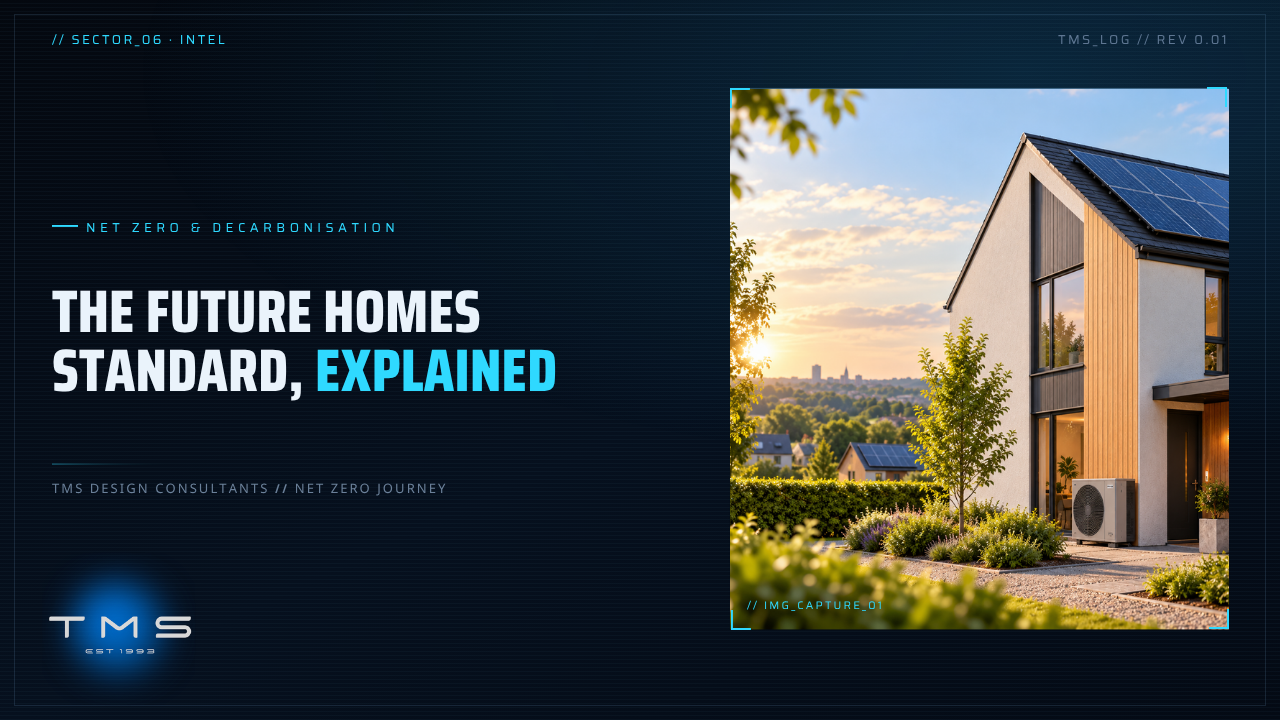
After years of consultation, the Future Homes Standard is confirmed. For anyone involved in residential development it changes the starting assumptions of a design, and it lands squarely on the building services. If you are a developer, contractor or architect with a scheme in the pipeline, the decisions made over the next couple of years will be shaped by it, ready or not.
The Timeline
The standard was published in March 2026 and comes into force on 24 March 2027, after a twelve-month transition period. Homes where construction has genuinely started before then can generally be completed under the previous 2021 requirements, but anything designed for delivery beyond that date has to meet the new bar. In practice, the schemes on drawing boards now are the first that will have to comply.
What Actually Changes
Four shifts carry most of the weight:
- Gas boilers are effectively out. New homes will be heated, for both space heating and hot water, by low-carbon systems, with heat pumps as the default technology.
- Solar PV becomes a standard expectation. New homes are expected to include photovoltaic panels, other than where a genuinely constrained roof makes it impractical.
- Fabric and airtightness targets tighten again, building on the 2021 uplift.
- The compliance methodology moves on, shifting from SAP 10.3 towards the government's new Home Energy Model.
None of these is a surprise in isolation, the industry has seen them coming for years, but taken together they reset the baseline for a residential design.
Why It Matters Now, Not in 2027
The trap is designing a scheme around a gas boiler on the assumption there is time to change it later. There rarely is. Heating technology influences emitter sizing, flow temperatures, plant space, electrical capacity and even the building fabric, so a late switch to a heat pump is not a swap, it is a redesign. The cheapest time to design for the Future Homes Standard is before the first assumptions are locked in.
What It Means for a Design Team
Meeting the standard well is less about any single product and more about how the pieces work together. In practice it puts renewed weight on a handful of things:
- Heat pump selection and sizing, and the flow temperatures and emitters that let them perform.
- Ventilation strategy, coordinated with a tighter, more airtight fabric (Approved Document F).
- Solar PV integration and the electrical capacity to support it, alongside EV charging where required.
- Overheating. More glazing and better airtightness raise the overheating risk, which brings Approved Document O and the associated modelling into play earlier than teams are used to.
Getting Ahead of It
The developers who find the transition smooth will be those who bring building services thinking in early, model performance at the design stage, and treat low-carbon heating as the basis of the design rather than a fix applied to a fossil-fuel one. Done that way, the standard is a well-understood set of requirements to plan around, not a scramble.
How TMS Can Help
Low-carbon building services are what we do. We design the mechanical, electrical and public health systems for residential schemes to meet current and emerging standards from the outset, coordinating heating, ventilation, renewables and controls so that a building is compliant, comfortable and efficient in use. If you have a residential scheme coming through in the next couple of years, it is worth building the Future Homes Standard in from the first sketch.